
Why Every Designer Should Leave the Computer
What painting murals taught me about design, scale, and creating experiences.
As designers, we spend countless hours behind our screens obsessing over typography, color palettes, layouts, and pixels. Those details matter, but they only tell part of the story.
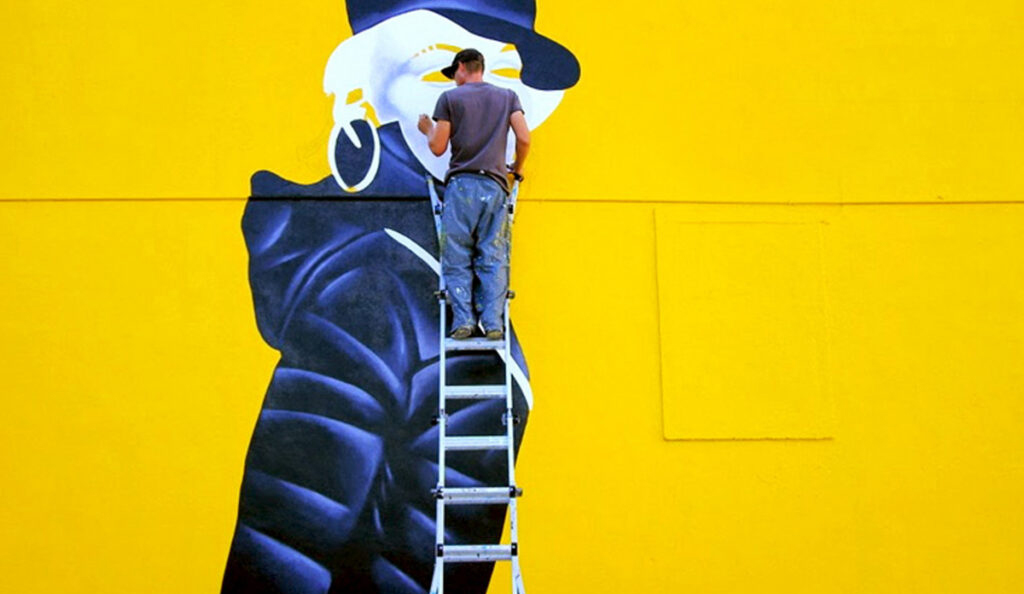
Some of the most valuable lessons I’ve learned about design didn’t happen in Illustrator or Photoshop. They happened standing in front of a 40-foot wall with a paint roller in my hand.
Painting large-scale murals completely changed the way I think about visual communication.
When you’re working on a mural, you quickly realize that design doesn’t exist at arm’s length. It exists in the real world.
People don’t experience your work from twelve inches away—they see it from across the street, from a moving car, or while walking through a neighborhood.
You begin to understand that scale changes everything.
Typography that looks perfect on a laptop can disappear on a building.
Colors shift dramatically depending on sunlight, shade, and weather.
Textures become part of the design.
Architecture influences composition.
Distance determines what people notice first.
Perhaps the biggest lesson is that people complete the design.
Watching someone stop to photograph a mural, smile as they walk by, or gather in front of it reminds you that design isn’t finished when you export a file. It’s finished when people experience it.
That perspective has influenced every project I take on today.
Whether I’m designing a brand identity, a website, an environmental graphic, or a marketing campaign, I think beyond the screen. I ask myself where people will encounter it, how they’ll interact with it, and what they’ll remember afterward.
Technology has transformed the way we create, but the purpose of design hasn’t changed. It’s still about connecting with people.
Sometimes the best way to become a better digital designer is to step away from the computer and create something that exists in the physical world.
Because great design doesn’t just live on screens.
It lives where people do.
Comments
Deirdre2949
July 7, 2026 at 8:06 amhttps://shorturl.fm/BtYng
Jaiden2360
July 7, 2026 at 12:12 pmhttps://shorturl.fm/hVnt2
Marco2300
July 7, 2026 at 3:13 pmhttps://shorturl.fm/VrGK0
Jay1227
July 7, 2026 at 3:57 pmhttps://shorturl.fm/w2jzV
Juan4354
July 8, 2026 at 3:02 pmhttps://shorturl.fm/mzXUb
Lindsey4742
July 8, 2026 at 10:30 pmhttps://shorturl.fm/Qpc7M
Lorelei4080
July 9, 2026 at 12:09 amhttps://shorturl.fm/AWGng
Kaylee976
July 9, 2026 at 12:33 amhttps://shorturl.fm/IWIxK
Alyssa2982
July 9, 2026 at 3:40 amhttps://shorturl.fm/0mcRT
Laila3671
July 9, 2026 at 7:58 amhttps://shorturl.fm/YgENd
Abby2118
July 9, 2026 at 2:01 pmhttps://shorturl.fm/6Sryw
Ignacio3400
July 9, 2026 at 4:48 pmhttps://shorturl.fm/7oIoR
Deirdre4901
July 9, 2026 at 6:41 pmhttps://shorturl.fm/TyxEz
Jayden316
July 16, 2026 at 7:10 amhttps://shorturl.fm/3Zw6W
Douglas259
July 16, 2026 at 9:04 amhttps://shorturl.fm/sqL2m
Jaxon1663
July 16, 2026 at 2:34 pmhttps://shorturl.fm/CtTno
Elliot3386
July 16, 2026 at 7:09 pmhttps://shorturl.fm/qUa00
Lana4931
July 16, 2026 at 7:54 pmhttps://shorturl.fm/uXYCY
Meagan701
July 16, 2026 at 9:28 pmhttps://shorturl.fm/EAfpz
Kathleen4663
July 17, 2026 at 8:38 amhttps://shorturl.fm/VcTKA
Logan3056
July 18, 2026 at 1:32 amhttps://shorturl.fm/4i22f
Joel4349
July 18, 2026 at 8:57 amhttps://shorturl.fm/SyCtX
Carey2826
July 18, 2026 at 11:17 pmhttps://shorturl.fm/fmYKL
Marley1216
July 19, 2026 at 2:19 amhttps://shorturl.fm/YB8UL
Briana3965
July 19, 2026 at 3:52 amhttps://shorturl.fm/LKd3l
John2893
July 19, 2026 at 5:27 amhttps://shorturl.fm/RqBhN
Daria2511
July 19, 2026 at 2:23 pmhttps://shorturl.fm/YjnOb
Nia2185
July 20, 2026 at 9:10 amhttps://shorturl.fm/04zOO
Daniella2737
July 21, 2026 at 4:36 pmhttps://shorturl.fm/R3F4m
Francesco685
July 22, 2026 at 1:47 amhttps://shorturl.fm/WFdEr
Lila1479
July 22, 2026 at 11:02 amhttps://shorturl.fm/au93D
Maggie2754
July 22, 2026 at 11:03 amhttps://shorturl.fm/k7trL
Peter3192
July 22, 2026 at 8:50 pmhttps://shorturl.fm/Ermzh
Troy176
July 22, 2026 at 11:13 pmhttps://shorturl.fm/6CND6
Marcus3458
July 23, 2026 at 3:27 pmhttps://shorturl.fm/t5yba
Maxwell2869
July 24, 2026 at 11:52 amhttps://shorturl.fm/7uwWb
Mariah2461
July 24, 2026 at 5:05 pmhttps://shorturl.fm/8yZ4C
Anne4338
July 24, 2026 at 5:45 pmhttps://shorturl.fm/f4jwD
Demi1335
July 24, 2026 at 10:58 pmhttps://shorturl.fm/wZzBu
Lana2708
July 25, 2026 at 5:02 pmhttps://shorturl.fm/GyQBI
Earl659
July 26, 2026 at 9:45 amhttps://shorturl.fm/4O4r4
Davis555
July 26, 2026 at 10:54 pmhttps://shorturl.fm/uvbED
Dorian1895
July 27, 2026 at 11:57 amhttps://shorturl.fm/9DrIC
Adrian4694
July 27, 2026 at 2:03 pmhttps://shorturl.fm/VTtQC
Florence2351
July 27, 2026 at 7:18 pmhttps://shorturl.fm/nTrgy
Jimmy2246
July 27, 2026 at 11:42 pmhttps://shorturl.fm/FU7X1
Lindsay4228
July 30, 2026 at 8:58 amhttps://shorturl.fm/U3YGT